

- Mettre en route la vidéo
- Cliquer sur l’icône « CC » (Sous-titre) en bas à droite
- Cliquer sur l’icône « Settings » (Paramètre) en bas à droite
- Cliquer sur «Subtitles » (Sous-titres)
- Cliquer sur « Auto-translate » (Traduire automatiquement)
- Sélectionner la langue de votre choix
HUSH: We Have Something to Say — The Final Episode
In a city where many newcomers carry untold stories and unspoken pain, HUSH stands as a call for civic awareness and shared responsibility. By giving voice to women who have survived state violence and exile, this final episode reminds us all: silence is never the end—speaking out is where belonging begins.
Sherry Soltani – Local Journalism Initiative
Vancouver, BC In a city shaped by migration and resilience, the voices of women who have survived political violence carry a civic weight that transcends borders. In the concluding episode of HUSH: (We Have Something to Say), a groundbreaking documentary series spotlighting Iranian women’s resistance, two former political prisoners now living in Canada break decades of silence. In a circle of shared vulnerability and strength, they reflect on the painful past and the challenges of exile. But their conversation—moderated by clinical counsellor and activist Dr. Pouran Poregbal is not only about remembrance. It is about responsibility, resilience, and the hard-won path toward civic belonging.
The episode opens with raw honesty. Mahboubeh, one of the participants, reflects:
“For years, I didn’t talk about what happened. But silence felt like another prison. I had to go back and remember the little girl I left behind—not to stay there, but to reclaim her.”
These women, all survivors of the Islamic Republic’s prison system, recount the deep scars of state violence, but they do so with dignity and purpose. Their stories transcend victimhood. As the conversation unfolds, we see how personal testimony becomes political power—and how healing can evolve into civic engagement.
Mehran AazamiFard, a community organizer and longtime advocate for refugee and women’s rights, speaks to the transformative role of safety and self-expression:
“At first, I didn’t even have the language to explain what had happened to me. But being in Canada gave me the safety to find words—and the responsibility to use them.”
For Mehran and her companions, the Canadian context has offered refuge—but not resolution. Belonging had to be earned, they say, through action.
“Canada gave me freedom,” Mehran reflects, “but I had to work for belonging. Joining local organizations, volunteering, helping newcomers—that’s how I became part of this society.”
Activism beyond borders
The conversation reveals that activism did not end when they left Iran. It transformed. Mahboubeh articulates this shift with quiet strength:
“We still fight. We still carry our people’s hopes with us. Activism didn’t stop—it just changed form.”
Whether supporting newcomers, speaking at panels, or advocating for human rights, these women embody a type of civic presence rooted in history but oriented toward the future. They emphasize that surviving trauma is only the beginning. What follows is the work of integration, mentorship, and public truth-telling.
Unpacking the emotional suitcase
A potent metaphor emerges during the episode: the idea of a suitcase carried across borders—filled not just with belongings, but with pain, longing, and untold stories.
“We arrive in a new country with more than clothes,” says Mehran. “We carry fear, guilt, memory. And we need to open that suitcase—not just for ourselves, but for our children.”
This unpacking is both painful and necessary. Therapy helped, the women say, but so did giving back. “Helping others was what truly freed me,” one guest admits. It became a way to reclaim agency and dignity, not just as former prisoners, but as active participants in Canadian civic life.
Interwoven traumas, shared resilience
Dr. Pouran Poregbal brings an additional layer to the conversation—linking the Iranian diaspora’s trauma to that of Indigenous communities in Canada.
“Like Iranians, Indigenous peoples have had to protect their language, culture, and identity against systemic erasure. Their endurance is a model for all of us,” she says.
This intersectional lens reinforces a powerful truth: civic healing must go beyond individual therapy.
It must be rooted in solidarity, justice, and the ethics of remembrance.
Woman, Life, Freedom—across generations
As the women reflect on recent protests in Iran—particularly the Zan, Zendegi, Azadi (Woman, Life, Freedom) movement—their words take on a renewed urgency.
“We’re watching from afar,” Mahboubeh says, “but our hearts are in the streets with them. Their courage keeps our own stories alive.”
“The revolution is not over,” Mehran adds. “Not there. Not here. It’s in how we live every day with honesty, compassion, and refusal to forget.”
As the final conversation draws to a close, host Sherry reminds us that HUSH is more than a documentary series—it is an open invitation to speak, to listen, and to build local understanding that can save lives.
If you have something to say, you are not alone,” Sherry concludes. “Programs like this bring hidden stories into the light. They remind women—especially those experiencing violence or isolation right here in Vancouver and across BC—that there is help, there is hope, and there is a community ready to listen.
Ajouter un commentaire

Skyrise Media is committed to reflecting the diversity and richness of the local community by providing programming in multiple languages and covering a wide range of topics in greater Vancouver.
Médias récents
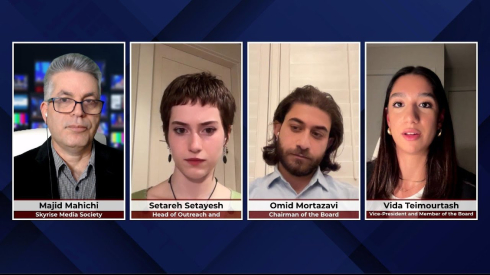
Students Build a Bridge to Hope: UBC Club Launches Simorgh Foundation for Iranian Education

Teen Voices: A Call for Safer Public Spaces in Vancouver

From Immigrant Struggle to Community Cornerstone

Commentaires
Nous encourageons les commentaires qui favorisent le dialogue sur les histoires que nous publions. Les commentaires seront modérés et publiés s'ils respectent ces lignes directrices:
Le portail des médias communautaires se réserve le droit de rejeter tout commentaire ne respectant pas ces normes minimales.